Anthropic Launches Claude Design
Anthropic Labs ships Claude Design: a visual design tool powered by Opus 4.7 that generates prototypes, slides, and marketing collateral from natural language. The design tool market just got more crowded.
Anthropic has launched Claude Design, the first product from its Anthropic Labs division. It’s a visual design tool powered by Claude Opus 4.7 that generates prototypes, pitch decks, one-pagers, and marketing collateral from natural language descriptions. Available now in research preview for all paid Claude subscribers.
What it does
Claude Design follows a familiar pattern: describe what you want, get a first version, then refine through conversation. But the implementation has some genuinely interesting angles.
Design system ingestion. During onboarding, Claude reads your codebase and existing design files to build a brand system. Colours, typography, components, all absorbed automatically. Every project after that stays on-brand. Teams can maintain multiple design systems if needed. This is smart. Most AI design tools spit out generic output that immediately screams “AI generated.” Building brand consistency in from the start avoids that problem.
Import from anywhere. Start from a text prompt, upload DOCX/PPTX/XLSX files, point Claude at your codebase, or use a web capture tool to grab elements from your live website. The web capture angle is particularly useful for product teams who want prototypes that look like the real thing, not a fantasy version of it.
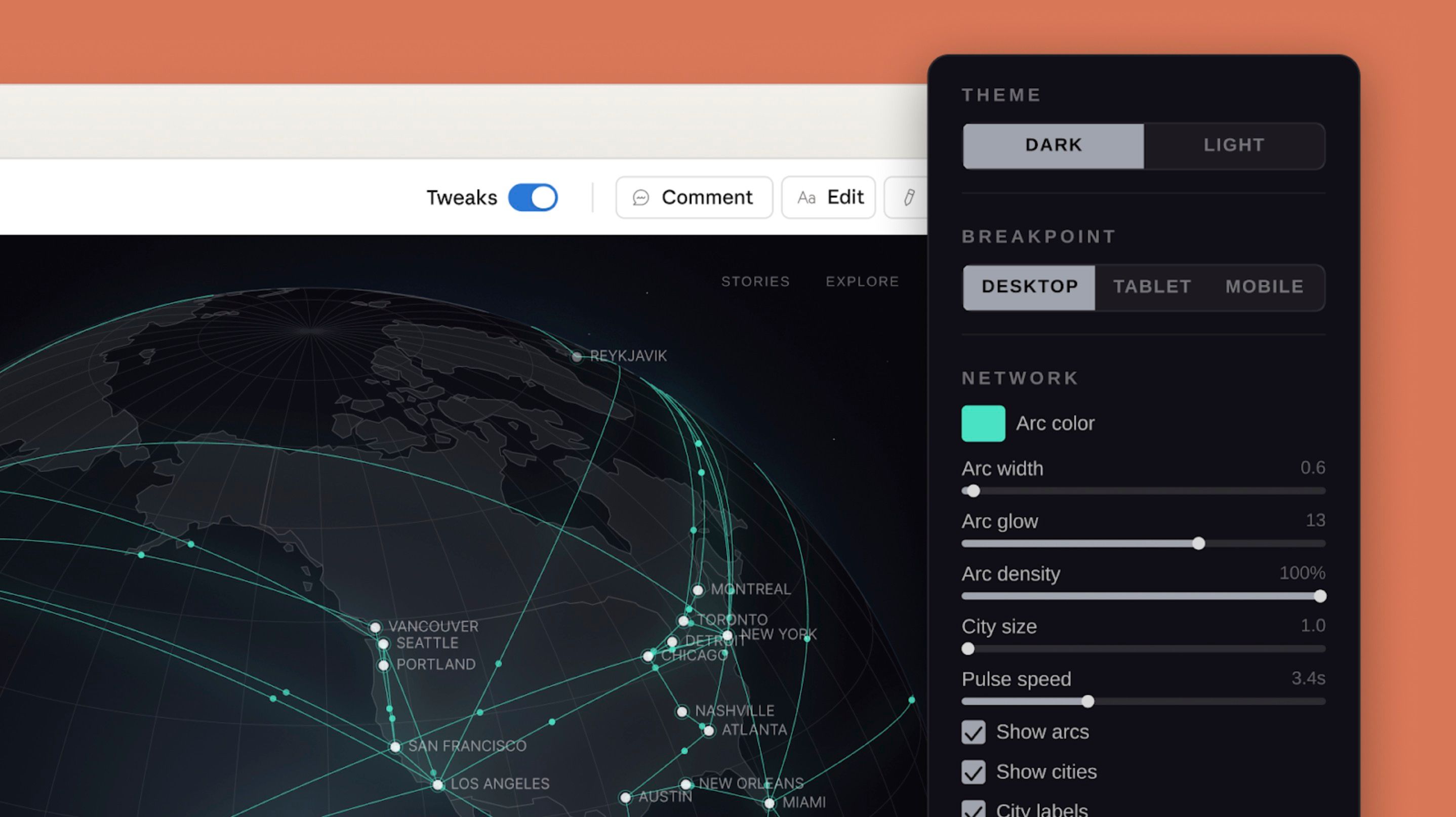
Fine-grained refinement. Inline comments on specific elements, direct text editing, and custom adjustment sliders for spacing, colour, and layout. Then ask Claude to propagate changes across the full design. The slider approach is a nice touch. It gives non-designers a way to tweak things without learning Figma or writing CSS.
Organisation-scoped collaboration. Keep documents private, share view links within your org, or grant edit access for collaborative editing. Group conversations where multiple people chat with Claude in the same design session. This is where it starts competing with Figma’s multiplayer model, albeit from a very different angle.
Export and handoff. Export to Canva, PDF, PPTX, or standalone HTML. There’s also a handoff bundle for Claude Code, packaging everything so the coding agent can implement the design. The Claude Code handoff is the sleeper feature here. If it works well, it closes the gap between “here’s what I want” and “here’s the production code” in a way no other tool does.
Why this matters
Anthropic is doing what it’s been doing all year: expanding horizontally into adjacent software categories. Model company. Consumer product. Developer tool. Workplace assistant. Now design tool. Each move adds another surface where Claude competes with existing software, and each surface feeds usage data back into model improvement.
The design tool market is already crowded. Figma owns professional design workflows. Canva owns the accessible end. Vercel v0 and similar AI tools own the code-to-UI pipeline. Claude Design is trying to sit between all of them: visual enough for non-designers, structured enough for professionals, and with a direct pipeline to code via the Claude Code handoff.
The timing with Opus 4.7 isn’t coincidental. Anthropic explicitly says Claude Design is powered by Opus 4.7’s improved vision capabilities. Higher resolution image understanding means the tool can actually see what it’s generating and iterate on it, rather than just throwing pixels at the wall. Whether that’s enough to produce output that professionals would ship rather than just demo remains to be seen.
The Figma angle
Figma shares dropped on the Opus 4.7 announcement, and Claude Design will put more pressure on. But the Figma partnership is interesting. Anthropic isn’t trying to replace Figma. The Canva export and the collaborative editing model both suggest Anthropic sees Claude Design as an ideation and prototyping tool that feeds into existing design workflows, not a replacement for them.
That’s probably the right positioning. Professional designers aren’t going to abandon Figma for an AI chat interface. But product managers, founders, and marketers who currently struggle to produce any visual output at all might find Claude Design genuinely useful. The “design exploration” use case, where a designer generates a dozen directions quickly and then refines the best one in Figma, feels like the most realistic near-term workflow.
Pricing and availability
Included with Claude Pro, Max, Team, and Enterprise subscriptions. Uses normal subscription limits, with the option to continue past them by enabling extra usage. Enterprise customers get it off by default, with admin controls to enable it. The fact that it’s included rather than a separate charge is notable. Anthropic is subsidising usage to drive adoption, which makes sense for a research preview but raises questions about what happens when the training wheels come off.
What I’m watching
Two things. First, output quality at scale. The demo materials look polished. Real-world use with real brand systems and real stakeholders is a different story. If the design system ingestion actually produces consistent, on-brand output across multiple projects, that’s a meaningful advance. If it degrades after the third iteration, it’s just another AI toy.
Second, the Claude Code handoff. If Anthropic has actually solved the design-to-code pipeline, where a prototype produced in Claude Design can be implemented by Claude Code without losing the design intent, that’s the kind of integrated workflow that no other tool provider can replicate right now. It’s the vertical integration play, and it could be genuinely powerful if it works.
Bottom line
Claude Design is Anthropic’s most ambitious product expansion yet. It’s not just another chat feature. It’s a full visual design tool that competes with existing software in a category that’s already nervous about AI. The design system ingestion, codebase integration, and Claude Code handoff give it angles that other AI design tools lack. Whether it produces professional-quality output at scale is the open question. But the positioning is sharp: ideation and prototyping for everyone, with a pipeline to production for developers. That’s a coherent story, and Anthropic is telling it well.